Paranormal Investigations
How I Investigate
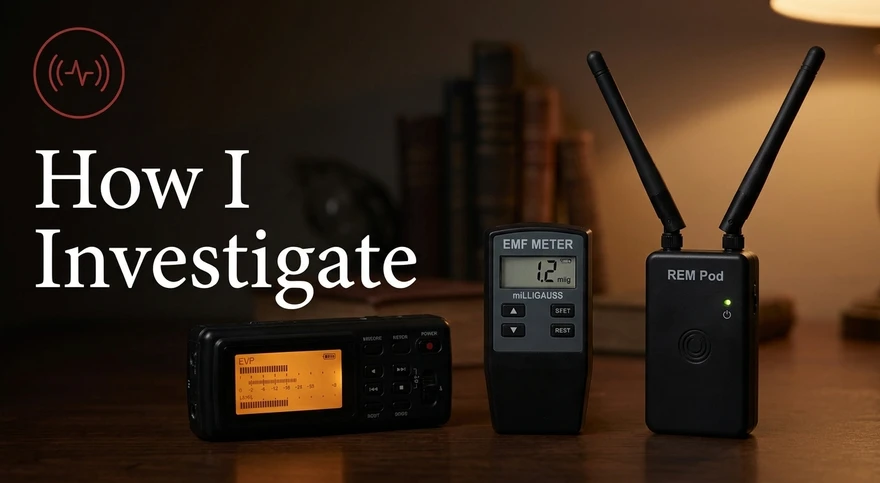
This isn’t a feelings-based walkthrough. It’s a total-coverage approach built on instruments, logged honestly, one device at a time - because a REM Pod going off and nothing else is still worth writing down exactly as it happened.
On this page
This is not a feelings-based walkthrough
People sometimes picture a paranormal investigation as someone standing quietly in a dark room, waiting to feel something. That is not what this is. It is an equipment-driven process built on instruments, not impressions, and the instruments do most of the actual work.
That distinction matters because it changes what a visit produces. A feeling is a single, unverifiable experience. A reading from an instrument, logged with the time, the room, and the conditions, is something that can be compared against every other reading from that same visit - which is the whole point.
What follows is the actual method: the principle behind it, the instruments involved, and why a single instrument going off alone still gets written down exactly as it happened.
The principle behind it: total coverage, not one tool
The approach is total coverage. Rather than relying on one method and hoping it is the right one, multiple instruments run at once, each built to pick up a different kind of signal. If something is actually happening, the goal is to have more than one way of catching it.
That also means accepting that the instruments will not always agree, and that disagreement is not a problem to explain away. It is the data.
In practice, that means several different kinds of instruments running in the same space at once, each one doing a narrow, specific job rather than being treated as a general-purpose ghost detector.
Setting up: where the instruments go and why
Instruments get placed with intention rather than scattered around. Areas where activity has actually been reported get priority, and the placement is chosen to cover as many angles of that space as the available equipment allows.
An EVP recorder typically runs continuously through a visit, since audio review happens afterward rather than in real time. A ghost box gets used in more focused stretches, listening actively rather than left running in the background. EMF readers and REM Pods stay fixed on the specific spots they are measuring, since neither reads a whole room. Cat balls sit in plain, visible locations as a simple physical check that does not depend on any electronics at all.
Everything gets logged with a timestamp as it happens, not reconstructed from memory afterward. That is the same habit that shows up elsewhere on this site: write down what actually happened, when it happened, before memory has a chance to round it up into something tidier.
Why one instrument going off alone still matters
A REM Pod can go off with every other instrument in the room reading nothing. An EVP recorder can pick something up on a night when nothing else moved. Neither of those results gets discarded for being alone, and neither gets inflated into more than it is.
- Log it exactly as it happened: which instrument, what time, what room, what was going on around it
- Do not wait for a second instrument to confirm it before writing it down
- Do not treat a lone reading as proof of anything beyond what that specific instrument is built to measure
- Come back to it later, once every instrument’s log from the visit is laid out side by side
That discipline is the actual method. It would be easy to only report the moments where two or three things happened together and call that the finding. It is more honest, and more useful, to report everything each instrument actually recorded, including the readings that stood alone.
The instruments, side by side
Here is what each one is actually built to catch, and what a reading from it means entirely on its own, before it is compared against anything else from the same visit.
| Instrument | What it’s built to detect | What a reading means on its own |
|---|---|---|
| EVP recorder | Audio, including sound outside the range or clarity of normal hearing | A captured sound worth reviewing - not a voice until it is actually reviewed and agreed on |
| Ghost box | Rapid radio-frequency sweeps, used to listen for words or fragments in the noise | A fragment worth logging with its exact timestamp, nothing more on its own |
| EMF reader | Fluctuations in electromagnetic fields in a specific spot | A spike worth noting - and worth ruling out against household wiring and appliances first |
| REM Pod | Disturbances in a small radial field it projects around itself | An alert at a specific moment, in a specific location, nothing beyond that alone |
| Cat balls | Movement or light response placed as simple, visible physical triggers | Movement observed and logged, checked against drafts and vibration first |
That is not a complete list of everything that might come out for a given visit, but it is the core of it, and it is representative of the approach: several different kinds of instruments, each doing one job, none of them asked to do more than that.
What this does and does not establish
None of this proves a property is haunted, and it is not built to. What it produces is an honest, instrument-by-instrument account of what happened during a specific visit, in a specific space, under specific conditions - which is a meaningfully different thing than a story, and considerably more useful to compare against a future visit or against what’s already been reported.
It also does not replace the disclosure and property-history research described elsewhere on this site. The two run alongside each other, not instead of each other, for the same reason a real estate decision and a paranormal investigation are two different questions with two different kinds of evidence behind them.
Where this fits into a visit you request
If a visit gets scheduled, this is the method behind it, start to finish:
- Instruments placed with intention around wherever activity has actually been reported
- Every reading logged the moment it happens, with the instrument, time, and room noted
- No result forced into agreement with another reading it does not actually have
- A full log handed back afterward, exactly as recorded, not a dramatized retelling of it
That record belongs to the homeowner or buyer who requested it, to use however it’s useful to them - alongside the real estate side of the conversation, or entirely apart from it. If you are curious enough to want a property looked into this way, that is a conversation worth having before or after a visit is scheduled, whichever makes more sense for where you are in the process.
This describes an investigative method and the instruments used in it. Instrument readings are not a scientific or legal determination that a property is or isn't haunted, and this does not replace the disclosure research described elsewhere on this site.
Written by