Haunted Buyers
What Should I Research Before Buying a Reportedly Haunted Home?
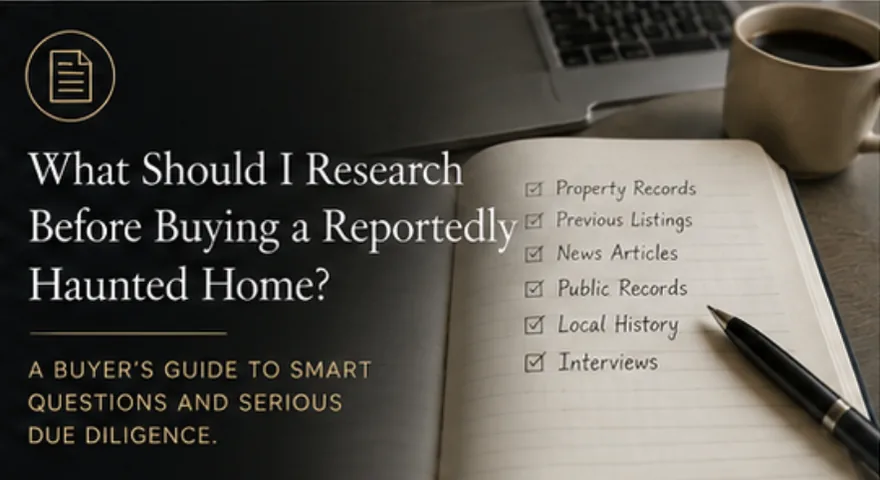
Two research jobs run in parallel: the ordinary one every buyer owes a house, and the one specific to a property with a history. Here is what each covers and where each stops.
On this page
There are two research jobs, not one
Buying a property with a reputation means doing everything an ordinary buyer does, and then a second body of work on top. The mistake almost everyone makes is letting the second job crowd out the first, because the second job is far more interesting.
The ordinary work is the one that determines whether you have made a good purchase. Condition, title, comparables, financing, inspection, the cost of the thing that is about to fail. A house with a fascinating history and a failing foundation is a house with a failing foundation.
The history work determines whether you have made an informed one. It tells you what you are buying alongside the building, what a future buyer is likely to discover, and whether the price in front of you reflects the story or ignores it.
The half that has nothing to do with the story
Run the standard due diligence exactly as you would on any other house, and run it first. A full inspection with the specific instruction to note anything the seller has drawn attention away from. A preliminary title report read properly rather than skimmed. Comparable sales, adjusted for condition.
Two ordinary items deserve extra attention on these properties. Insurance should be quoted early rather than at the end, because an older property, a vacancy period or a prior claim can all complicate a policy, and none of those have anything to do with the reputation. Appraisal matters because your lender’s appraiser will value the house on comparable sales and physical condition, and will not be pricing in a story either way.
Vacancy is worth its own look. Properties with reputations sometimes sit empty for long stretches, and an empty house deteriorates in specific, predictable and expensive ways. Plumbing, pests, roof, and the slow damage of a building nobody has heated for three winters.
The half that is specific to the history
The history research has one goal: establish what is documented, what has only been reported, and what nobody can currently tell you. Not to resolve the paranormal claim, which cannot be resolved, but to know precisely what you are deciding on.
Work outward from the address rather than inward from the story. Ownership chain from the county recorder, permit history from the building department, every previous listing you can retrieve including expired and withdrawn ones, and a newspaper archive search on the street address rather than on the current owner’s name.
Search the address, not the legend. A folklore search returns the story as it currently circulates, which is the version furthest from the source. An address search returns records, including the ones nobody attached to the story because they did not know the story existed.
The four questions to put in writing
Ask the seller directly and keep the answer. In California, a direct question changes the legal position of the person answering it, which is covered in a separate article, and it only does so if there is a record.
- Has anyone died on this property, and if so, approximately when?
- Are you aware of any event at this address reported in news coverage, online, or by neighbours?
- Has this property been marketed before with any reference to its history or reputation?
- Is there anything about this property’s past that you would want to know if you were buying it?
That fourth question is the one that produces answers. It is broad enough that a narrow response becomes conspicuous, and it is difficult to answer carelessly.
What each source gives you, and where it stops
Every source has a boundary, and most bad information about these properties comes from someone running a source past its own limit.
| Source | What it gives you | Where it stops |
|---|---|---|
| County recorder | The ownership chain, dates, transfer types | Says nothing about events inside the house |
| Building permits | Structure, additions, repairs, dates of work | A gap is a question, not an answer |
| Previous listings | Photos, price history, remarks, withdrawals | Only covers periods the house was for sale |
| Newspaper archive | Contemporaneous reporting, names, dates | Early reporting is often wrong and never corrected |
| Former occupants | First-hand accounts, the earliest version | Recollection, not record |
Write down which column each fact came from. Six weeks later every note in your file will look equally authoritative, and the only thing separating a deed from a rumour will be whether you labelled it at the time.
Financing, insurance and the appraisal
No lender has a policy about haunted houses, and no underwriter is going to ask. What lenders care about is condition, value and marketability, and a property’s reputation only reaches them indirectly, through comparable sales and the appraiser’s judgement about how readily the house would resell.
Insurance is the one to sort out early. Age, vacancy history, prior claims and the current California wildfire environment will all shape what a policy costs and who will write it, and in the mountain and high desert communities where a lot of these properties sit, that conversation is worth having before you are in escrow rather than during.
Think about resale now, not later
Whatever you conclude about the property, the next buyer will run this same process, and they will find whatever you found. Deciding now how you feel about that is considerably cheaper than discovering it in four years.
- The story does not go away when the house changes hands. If anything the sale adds to it
- Documented history stays documented. Anything you found in an archive, a future buyer finds too
- Your buyer pool at resale is smaller and different, not necessarily worse
- A property already known for its history is easier to sell than one where the story surfaces mid escrow
None of that is a reason not to buy. It is a reason to buy with the resale conversation already had, which is a materially different position from buying and hoping it never comes up.
This describes publicly available California statute and case law for general information. It is not legal advice, and disclosure obligations turn on the facts of a specific transaction. Confirm anything material to your situation with a qualified California real estate attorney.

Written by