Haunted Sellers
Is Your House Haunted, or Is It Just the Pipes?
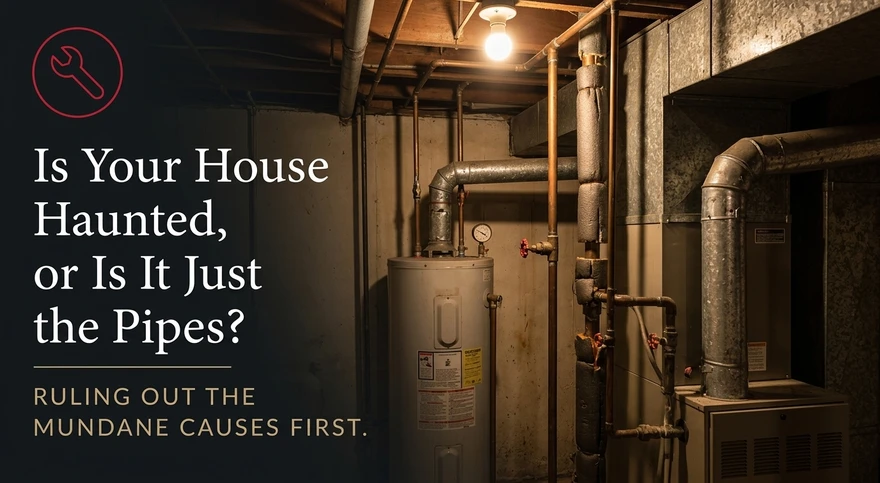
Most of what gets reported as paranormal activity has a mundane explanation sitting right underneath it. Before a seller decides a house has a reputation worth addressing, it’s worth ruling out the house itself.
On this page
Before you market a reputation, rule out the plumbing
Every haunted house story has a physical house underneath it, and physical houses make noise, creak, hum, and occasionally do something that looks more dramatic than it is. Before a seller decides a property’s reputation is worth addressing - or marketing - it’s worth a few phone calls ruling out what a licensed professional can explain in an afternoon.
This is the companion question to "how can you tell your house is haunted," and it deserves the same measured treatment. Not every cold spot is a draft and not every knock in the pipes is a metaphor - but a striking number of them are, and finding that out is cheap compared to guessing wrong in either direction.
None of this is about being a skeptic for its own sake. It’s about sequencing: rule out what a contractor, a plumber, or a pest control technician can settle definitively, before you spend energy on what nobody can.
Why this is worth doing first
There are practical reasons to do the mundane check first, starting with cost. A pest inspection, an HVAC service call, or a plumber’s visit is a bounded expense with a clear answer. Chasing an unexplained phenomenon with no professional who can rule it out definitively is a much longer, much less bounded project.
There’s also a marketing reason. If a seller decides to address a reputation, that decision should rest on what’s actually true about the house, not an assumption that turns out to be a squirrel in the attic. Getting the physical explanation wrong costs you either way: overreacting to a drafty window, or underreacting to a real structural issue dressed up as folklore.
And there’s a plain fairness reason. A house with real electrical problems or an active pest issue deserves those fixed regardless of what anyone believes about it. That work needs doing either way, so it may as well come first.
How an ordinary house produces extraordinary-sounding evidence
Houses are noisy, dynamic objects. Wood framing expands and contracts with temperature change, and it does so audibly - a tick, a creak, a settling sound overnight when the house cools faster than the ground beneath it. None of that requires anything unusual to be true.
Air moves through a house constantly, through gaps around old windows and doors, through duct runs, through the attic. Moving air reads as a cold spot or a draft, and it reads that way whether or not anyone in the house consciously notices the airflow itself.
Older plumbing and electrical systems weren’t built to modern standards and they show it: galvanized pipe bangs when water hammer hits it, aging wiring can flicker a circuit, and none of that is rare in a house old enough to have accumulated a reputation in the first place.
The usual suspects
Before any of this needs a formal inspection, a seller can usually narrow things down just by asking a few plain questions about the house’s age and systems:
- How old is the house, and when were the plumbing and electrical systems last updated?
- Is there an attic or crawlspace that hasn’t been checked for wildlife in the last few years?
- Does the HVAC system run on a schedule that lines up with when the "activity" tends to get reported?
- Are the reported sounds or sensations tied to a specific room, time of day, or season - the kind of pattern a mundane cause usually leaves behind?
If the answers point toward an old system, an unchecked attic, or a seasonal pattern, that’s usually enough reason to call a professional before concluding anything else.
The reference: what’s probably behind it
Here’s a plain reference for the most common complaints and the mundane explanation most likely sitting underneath each one:
| What gets reported | Most likely mundane cause | How a professional confirms it |
|---|---|---|
| Footsteps or creaking overnight | Wood framing settling with temperature change | A contractor can trace the sound to specific framing members and temperature swings |
| A cold spot in one particular room | A draft from an old window, door, or duct leak | An energy audit or simple hand test finds the airflow directly |
| Banging or knocking in the walls | Water hammer or aging galvanized plumbing | A licensed plumber can reproduce it by running specific fixtures |
| Scratching or scurrying in walls or the attic | Wildlife - rodents, squirrels, or birds - nesting in the attic or wall cavities | A pest control inspection finds droppings, nesting material, or entry points |
| Flickering lights or odd electrical behavior | Aging wiring, a loose connection, or an overloaded circuit | A licensed electrician finds it with a standard inspection, and it needs fixing regardless |
None of these findings are exotic, and that’s the point - they’re the first, most likely explanation, and ruling them in or out is fast.
What ruling this out doesn’t settle
Ruling out the mundane causes doesn’t prove there’s nothing else going on, and it isn’t meant to. It closes off the explanations that are genuinely easy to check, which leaves whatever remains in the same honest place it started: reported, not documented, and not something this article is set up to resolve either way.
That remainder belongs in the same four-category framework as everything else about a haunted reputation. A physical explanation ruled out is one fewer thing sitting in the unknown column - it isn’t evidence for or against anything paranormal, it’s just good housekeeping done before a listing strategy gets built.
The order to make the calls
If you’re getting ready to rule things out before deciding how to handle a reputation, the calls are usually worth making in roughly this order:
- A general contractor or home inspector, for structural settling, framing, and general condition.
- An HVAC technician, for anything that behaves on a schedule or seasonally.
- A licensed plumber, for banging, knocking, or anything water-related.
- A pest control professional, for the attic, crawlspace, and wall cavities.
If everything checks out and something still doesn’t have an explanation, that’s a real, honest unknown - and for a seller who wants that looked into directly rather than left as a question mark, Lindsey’s Haunted Realtor services include a no-cost paranormal team visit built for exactly that.
This describes publicly available California statute and general practice for general information. It is not legal advice, and disclosure obligations turn on the facts of a specific transaction. Confirm anything material to your situation with a qualified California real estate attorney.

Written by